Good to know
Frequently Asked Questions About Teeth Whitening
+Why do teeth become discoloured over time?
Tooth discolouration is not caused by a single factor. It is usually the result of gradual changes over time.
External staining is the most common cause. This comes from repeated exposure to pigments in food and drinks such as coffee, tea, red wine, and certain sauces. Smoking also contributes significantly, as tar and nicotine bind to enamel.
Internal changes also play a role. As we age, the outer enamel layer becomes thinner. This makes the underlying dentine, which is naturally more yellow, more visible. In some cases, previous dental trauma or developmental conditions can cause deeper discolouration that is not easily removed.
Dr Sin Ting Chui evaluates the type and depth of staining before recommending whitening, as this determines how effective the treatment will be.
+Does teeth whitening work for everyone?
Whitening works well in many cases, but not universally.
It is most effective on natural teeth with mild to moderate staining. However, results can be limited if the discolouration is deep or caused by intrinsic factors such as trauma or certain medications.
It is also important to understand that whitening does not change the colour of dental restorations. Fillings, crowns, and veneers will remain the same shade, which may create a contrast if surrounding teeth become lighter.
This is why assessment is important. In some situations, whitening alone may not achieve the desired outcome, and alternative approaches may be discussed.
+Is professional whitening safe?
Yes, when it is properly planned and supervised.
Before treatment, we assess the health of your teeth and gums to ensure there are no underlying issues such as decay or inflammation. Whitening agents are then used in controlled concentrations to minimise irritation.
Dr Sin Ting Chui takes a conservative approach, ensuring that whitening is suitable for your specific oral condition rather than applying a standard protocol.
+Will whitening damage my enamel?
No, professional whitening does not remove or weaken enamel.
The process works by breaking down stain molecules within the tooth structure, not by stripping the surface.
However, misuse of over-the-counter products or excessive whitening can lead to increased sensitivity or gum irritation. This is why a controlled approach is important.
+Why do some people experience sensitivity after whitening?
Sensitivity is one of the more common temporary side effects.
During whitening, the enamel becomes more permeable for a short period. This allows external stimuli, such as cold air or drinks, to reach the nerve more easily.
In most cases, this sensitivity is mild and resolves within a few days.
For patients who already have sensitive teeth, Dr Sin Ting Chui may adjust the treatment plan — for example, by using a lower concentration or spacing out sessions — to reduce discomfort.
+How long does teeth whitening last?
Whitening is not permanent.
The duration of results depends on lifestyle factors such as diet, smoking, and oral hygiene. Patients who frequently consume staining substances may notice gradual darkening over time.
That said, many patients maintain a noticeable improvement for months or even years with proper care. Periodic top-up treatments can help maintain consistency.
+Can I whiten my teeth if I have fillings or crowns?
Yes, but with some limitations.
Whitening only affects natural tooth structure. Existing restorations will not change colour. This means that after whitening, there may be a visible difference between natural teeth and restorations.
Dr Chui discusses this clearly before treatment so that expectations are realistic. In some cases, replacing older restorations after whitening may be considered to achieve a more uniform appearance.
+Is in-chair whitening better than take-home whitening?
Both methods are effective, but they work differently.
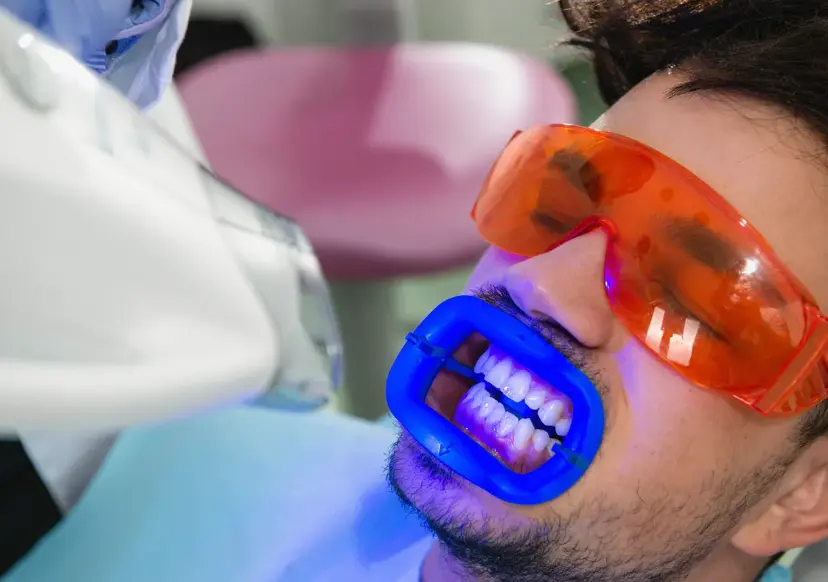
In-chair whitening provides faster results under professional supervision. It is suitable for patients who want noticeable improvement in a shorter time.
Take-home whitening allows for gradual change over a longer period. It offers more control and may be more suitable for patients with sensitivity.
The choice depends on individual preferences, goals, and oral condition.